A Family Story Night Built Around a Comic Character
Plan a family story night around a comic character with gentle prompts and flexible turns, so guests can invent a funny everyday problem to solve together.
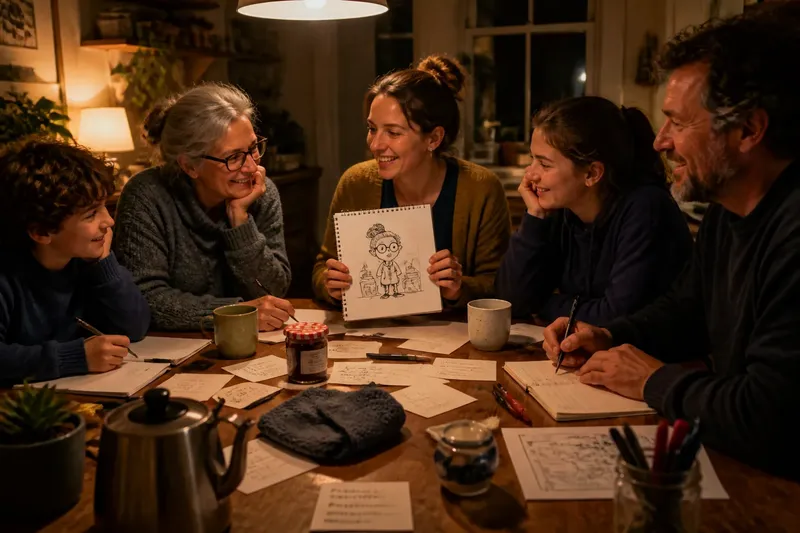
A family story night built around a comic character works best when everyone shares one small, harmless problem and gets room to make the character their own. Start with a missing mitten, a stubborn jar lid or a serious misunderstanding about a houseplant; the fun comes from how differently each person handles it.
This plan keeps the evening relaxed rather than turning it into a performance contest. You will need paper, pens and a few ordinary objects for prompts. No one has to be quick, polished or comfortable speaking to the whole group.
Choose a problem small enough to play with
Give the evening a modest starting point. A comic character is easier to invent when the trouble is clear, familiar and low-stakes. A sock has gone missing; the kettle has been put in an unusual place; someone has brought home a plant without knowing what it needs. These situations invite imagination without asking anyone to perform distress or make a real family disagreement into a joke.
Offer a short menu, then let the group choose one. A shared problem gives the stories a loose connection, but each guest can take it in a different direction. The character might be a neighbour, a talking pigeon, a retired pirate or a child who believes every household object has a job title.
Set a gentle boundary before the first story: the joke is about the character’s habits and choices, not a guest’s appearance, private worries or vulnerabilities. If someone would rather not use a prompt, let them pass or pick another. The point is to make room for silliness without making anyone the target.
Keep the problem ordinary, not personal.
Give everyone one distinctive character
Ask each guest to choose a name, a strong preference and a small flaw. The preference could be a fondness for labels, a belief that every decision requires a committee or an insistence on wearing a raincoat indoors. The flaw should create comic friction: perhaps the character is too proud to ask for help, too literal to understand a hint or convinced that a tiny task needs elaborate preparation.
Keep the character recognisable with just a few details. A name and a repeated habit often do more than a long biography. If a guest wants a prompt, ask: What does this person think they are good at? What do they avoid? What do they do when nobody agrees with them?
It can help to write the details on a slip of paper. A guest who does not want to invent aloud can draw or dictate their ideas, and a younger participant can ask someone else to be their scribe. Allow people to invent together if that feels easier.
One clear habit gives the audience something to recognise as the story moves.
Set the story somewhere familiar
Place the character somewhere everyone can imagine: at the kitchen table, in a queue, beside the recycling bin or in a draughty hallway. A familiar setting supplies useful details without needing a long explanation. The story can make a small object important—the tea towel, the umbrella stand, the shopping list—but there is no need to build an elaborate world.
Invite the storyteller to mention one or two details the group can picture. A wobbly chair or a cupboard door that will not quite close gives the character something to react to. Keep the description brief so the story starts moving before attention drifts.
Say you choose Auntie June, who labels every container, and the problem is a jam jar with no label. She searches for a marker, convenes a tasting panel, then accuses the jar of being uncooperative. The setting stays at the breakfast table, while her particular habit drives the trouble.
Use an ordinary room as a stage; familiar objects do the scene-setting for you.
Give the character a simple story shape
A compact shape helps a guest who is unsure how to begin. The character wants to solve the shared problem, tries a solution that suits their personality and meets a small complication. They try again, perhaps making matters more awkward, then reach an ending that feels satisfying or surprising. This is a flexible guide, not a formula everyone must follow.
For example, the label-loving character may name the jar “mystery fruit”, then “possible breakfast”, before deciding the safest label is “ask someone”. The result need not have a clever twist. A quiet, sensible ending can be funny if it shows how far the character has travelled to reach it.
Offer a few starter prompts on slips of paper for anyone who gets stuck:
- “The first thing my character tried was…”
- “They thought the problem meant…”
- “The helpful object turned out to be…”
- “At last, they decided…”
Let the storyteller skip any prompt that does not fit. A useful structure should support invention, not make every story sound alike.
Share the storytelling without demanding a performance
Make the invitation clear: guests can tell, read, draw or help someone else tell a story. One person might describe their character while another supplies the character’s lines. Someone who prefers not to speak can sketch the setting or choose an object that belongs in it.
Keep turns brief enough for the group to stay interested, but do not rush anyone finding their words. The host can offer a gentle prompt—“What does the character do next?”—rather than finishing the story for them. If a guest loses their place, a pause is fine. Silence can be part of thinking, not a sign that the story has failed.
For a mixed-age group, pair willing guests so children and adults can share the work. Do not appoint anyone to perform, imitate an accent or act out a role without asking first. A character can be vivid on the page; a theatrical voice is optional.
Keep participation flexible, and the room has more ways to join in.
Listen for the character’s point of view
After each tale, invite one specific response about the character’s choices. “What did they care about most?” or “Which object did they trust?” keeps attention on the invented person rather than asking for a verdict on whether the story was funny. Guests can also name a detail they remember, such as the character’s grand plan for a humble tea towel.
Do not demand laughter as evidence that a story worked. People show enjoyment differently, and some stories land through a quiet image or a recognisable habit. A warm response can be a question, a grin or a contribution to the character’s next adventure. If the group naturally laughs, let that moment breathe before moving on.
Keep feedback kind and concrete. If someone wants to add an idea, ask the storyteller first: the character belongs to the person who made them. This small courtesy protects the pleasure of inventing, especially for a guest trying storytelling for the first time.
Ask about the character’s choices, not the storyteller’s talent.
Add a shared ending without taking over
When everyone has had a turn, invite the group to choose one gentle closing question: What might the characters do tomorrow? Which one would be trusted to look after the houseplant? What object would they all bring to a picnic? Each guest can offer a sentence, or simply listen while others build a little shared scene.
Keep the ending open enough that no one has to invent a perfect conclusion. The characters might meet again in the hallway, exchange advice or disagree about the proper use of a shopping list. A final image can close the evening more neatly than a forced punchline.
If the group is enjoying the activity, write down character names and a few favourite habits for another gathering. Do not preserve anyone’s story without permission, especially if it includes details the storyteller would rather keep within the room. A note can be as simple as “Auntie June labels everything” and still help everyone remember the character.
What can help when a story stalls?
How can a shy guest take part?
Offer drawing, writing, choosing an object or co-telling with a trusted partner. Make passing a valid choice, so participation does not feel like a test.
What if the problem feels too difficult?
Make it smaller and more concrete: a missing spoon is easier to play with than a vague family disagreement. Let the storyteller swap the prompt if it no longer feels comfortable.
How do you keep the stories from sounding alike?
Give each character a different preference or habit, then let that trait shape their response to the same problem. The shared setup connects the stories; the characters’ choices distinguish them.
What if someone makes a joke at another guest’s expense?
Redirect the story towards the invented character’s own choices or the harmless object causing trouble. If a guest seems uncomfortable, pause and change the prompt rather than asking them to explain their reaction.
Close while the room still feels playful
End after the shared scene or a final round of favourite character details, before the activity starts to feel like an obligation. Thank guests for the ideas they contributed, including the quiet ones. The aim is not to produce a polished tale; it is to let each person see how one small problem changes when a different character takes charge.
For a family story night built around a comic character, the most useful keepsake is often a phrase or habit the group can bring back later. A labelled jam jar, a stubborn umbrella or a character who consults the furniture can become a gentle callback at another gathering. Keep the callback affectionate and optional, and the story can travel beyond the evening without turning its creator into the joke.