The Second Meaning Waiting in a Punchline
Learn how a punchline’s second meaning can flip an earlier phrase, with a made-up everyday exchange and a week-long routine for shaping the turn.

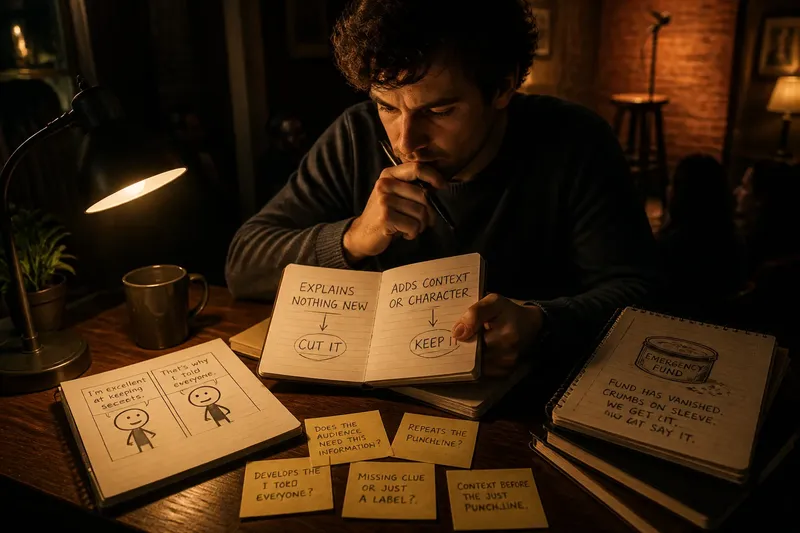
A punchline can make an ordinary phrase change direction without changing a word. In a second-meaning punchline, the audience first hears a phrase one way, then the ending supplies another reading that makes the earlier one look newly comic. The craft lies in planting a phrase that can bear both meanings—and letting the later one arrive clearly.
What changes when a phrase gets a second meaning?
Think of a phrase as a small door that opens in two directions. At first, the listener chooses the obvious route. The punchline then reveals a different route, and the earlier words seem to have been pointing there all along.
Say a neighbour asks, “How did your new flatmate settle in?” The reply is, “Very quietly. I haven’t told them I’m the landlord.” The phrase “settle in” initially suggests getting comfortable in a home. The landlord reveal gives it a second shade: settling an account or arranging terms. The exchange is invented, but the mechanism is useful to study: a familiar phrase arrives first, then a specific fact changes what it can mean.
The turn is not simply an unexpected last word. Surprise opens the door; reinterpretation gives the surprise its shape. If the ending has no meaningful link to the setup, it may feel random. If the link is too obvious, the audience gets there before the punchline.
How do you choose a phrase that can turn?
Begin with an everyday expression that already carries more than one plausible sense. “Take a break”, “lose your place”, “keep an eye on it” and “make a scene” all invite different readings, but a phrase is only useful if you can build a believable exchange around both.
Write down the first meaning a listener is likely to hear. Then ask what concrete situation could make the phrase mean something else. “Keep an eye on it” might be about watching a bag; a later reference to an eye painted on the bag could turn the phrase literally. That premise is clear, though it may need a sharper surprise than a simple explanation.
Prefer a turn that grows from the people and place in the setup. A café, a shared kitchen or a train platform gives you ordinary details to work with. A phrase chosen only because it has two dictionary meanings can leave the exchange stiff; a phrase someone might actually say gives the audience a reason to accept the first reading.
What should you do on each day of a week?
A week-long routine gives one phrase room to develop without demanding a finished joke at every sitting. Keep each session short enough that you can hear the wording afresh the next day.
- Monday: Collect. Note overheard-sounding phrases from invented situations, such as a booking clerk saying “You’re on the list”. Do not write punchlines yet; record what the phrase would ordinarily mean.
- Tuesday: Split the meanings. For each phrase, write its likely first reading and a distinct second reading. Set aside candidates where the second sense needs a long explanation.
- Wednesday: Give it a scene. Choose a place and a speaker who could naturally use the phrase. Add only the detail needed to make the first meaning feel secure.
- Thursday: Draft the turn. Write several short endings that make the alternate meaning clear. Keep the reveal in the final beat, not buried in a paragraph of explanation.
- Friday: Read aloud. Mark where the sentence naturally pauses. Try a brief pause before the turn, but avoid stretching it so long that the audience starts searching for the trick.
- Saturday: Remove clues that give it away. Cut unnecessary wording that points too directly towards the second sense. Keep enough context for the setup to remain intelligible.
- Sunday: Check the landing. Read the exchange to a willing listener, then ask what they thought the phrase meant at first and what changed. Treat their answer as a clue about clarity, not a verdict on whether the joke is funny.
How much setup does the second meaning need?
Enough to establish the first reading, but not enough to explain the later one in advance. The audience needs a plausible reason to hear the phrase normally. A few precise details usually do more than a long preamble.
Imagine you are writing about a friend who says, “I’ve got the place to myself,” while guarding a reserved seat on a crowded bus. If the next line reveals that the “place” is a tiny patch of floor marked by their own luggage, the phrase shifts from a home or venue to a physical spot. The invented exchange gives the listener an initial assumption, a concrete object and a clear reinterpretation. If the setup instead explains the bus, the luggage, the reservation and the friend’s habits, the turn risks arriving after its energy has gone.
Check whether the opening still sounds natural without the punchline. If it reads like a riddle deliberately hiding a clue, adjust the speaker’s reason for saying it. The best setup is not invisible; it simply feels like part of the conversation.
How can you tell if the turn is clear?
These questions help you inspect the mechanics without treating laughter as a pass-or-fail score.
Does the punchline change an earlier phrase?
Point to the exact word or expression that acquires a new sense. If you cannot identify one, the ending may be surprising for another reason, but it is not doing this particular kind of work.
Can the audience hear the first meaning before the reveal?
Read only the setup and ask what interpretation it invites. If the second meaning is already strongly signalled, soften that clue or choose a more ordinary opening.
Does the ending make the second meaning concrete?
A broad hint such as “you know what I mean” asks the listener to finish the joke for you. A clear noun, action or circumstance lets the reinterpretation click without a follow-up explanation.
Would a shorter setup make the turn land sooner?
Remove one phrase at a time and read the exchange again. Keep any detail that supports the first reading or makes the reveal intelligible; cut details that merely repeat information.
When should you revise instead of explaining?
If a listener misses the second meaning, resist adding a sentence that spells it out. That extra line often replaces the moment of recognition with a lesson in how to understand the joke. First check the phrase, the order of information and the clarity of the reveal.
Try reading the setup with a neutral voice, then give the final words a clean landing. A small pause can separate the expected reading from the new one, but the wording must carry the turn. If the joke only works after you describe the intended interpretation, the phrase may not be doing enough.
Return to your notes and test another ending against the same setup, or keep the phrase and invent a different scene. The week-long routine is there to make those choices visible, not to force every double meaning into a finished joke. For a second-meaning punchline, the most useful final check is simple: can the listener point to the earlier phrase and say why it means something different now?