The Mistake of Explaining the Joke Too Soon
Explaining a joke too soon can drain its force. Learn when to cut a line, add a missing clue or let the audience make the comic connection themselves.
Explaining a joke too soon can drain its force. The trouble is not the extra sentence itself; it is that the sentence may arrive after the audience has already understood the comic turn. A useful edit asks what the explanation contributes: a missing piece of meaning, or merely a label for a connection that is already clear?
When does a joke already explain itself?
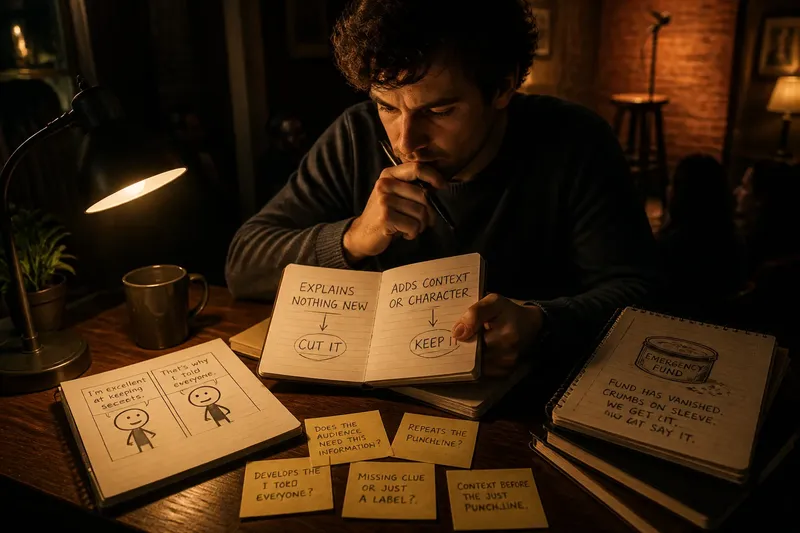
A contradiction often carries its own explanation. A character who declares, “I’m excellent at keeping secrets,” then admits, “That’s why I told everyone,” has made the gap between claim and behaviour plain. A further line spelling out the contradiction would repeat information rather than add a comic idea.
Look for what the audience needs to infer. If the setup supplies one expectation and the next line or action overturns it, the audience can make that connection without a verbal guide. Trusting the connection keeps the audience active and lets the joke remain brisk.
Imagine a scene where a character labels a biscuit tin “Emergency Fund”, then complains that the fund has vanished while crumbs cling to their sleeve. The label and crumbs provide the clue; a line announcing that the character ate the biscuits would simply name what the audience can infer. Keep the line only if it reveals a fresh detail, such as the character insisting the crumbs are an unrelated financial crisis.
When should you add a missing clue?
Clarification helps when the audience lacks information needed to understand the turn. Perhaps the joke depends on a phrase with a particular meaning, a character’s earlier promise, or an object whose identity is unclear. In that case, explain the relevant premise before the punchline, not the punchline after it.
Keep the clue precise. If a character uses a local expression, another line can establish its meaning in the conversation before the reversal. If a joke depends on a promise made earlier in a long scene, a brief reminder of that promise can reconnect the setup to the payoff. Neither needs to announce why the audience should laugh.
Say you are writing a scene in which a character calls a cactus “a very prickly cucumber” after boasting about knowing every plant. If the cactus has already been identified, the misidentification carries the joke. If the audience has not been told what the plant is, add a simple setup cue such as “This cactus is thriving,” then let the confident mistake do the comic work; a line explaining that the speaker is wrong would add no new clue.
How can you tell what an extra line is doing?
Read the scene once without the proposed explanation. Then ask what a reader would no longer know. If the answer is only “that the character is mistaken” or “that the situation is ironic”, the line may be repeating the turn. If the answer is a concrete fact needed to follow the action, put that fact where the audience can use it.
Use this check while revising:
- Observation: The audience can identify the setup and the reversal without the line. If the action still makes sense, then cut the line; otherwise, identify the missing fact and add that fact to the setup.
- Observation: The line introduces a necessary name, object or past event. If the audience needs it to understand the turn, then move it before the punchline; otherwise, remove it if it only repeats known information.
- Observation: The sentence contains several ideas that are hard to follow. If the comic turn is buried in that wording, then simplify the sentence; otherwise, leave the wording alone and check whether the issue is actually missing context.
- Observation: The explanation changes the character’s behaviour or exposes a motive. If it adds a new comic trait, then keep or reshape it; otherwise, cut it if it merely repeats the joke’s meaning.
- Observation: The joke relies on a reference not established in the scene. If the reference matters, then supply a short piece of context beforehand; otherwise, replace it with a turn the scene can support.
- Observation: The same idea is repeated in successive lines. If each return changes the stakes or meaning, then keep the progression; otherwise, remove the repeated beat.
What questions help you decide whether to explain a joke?
Should I explain a joke if a reader misses it?
First identify what the reader could not follow: a word, a reference, a relationship or the comic reversal. Add that missing information where it helps the audience understand the setup, rather than writing a line that states the joke’s meaning.
How do I know if a line repeats the punchline?
Remove the line and check whether the audience can still identify what changed between expectation and outcome. If the turn remains clear and the line adds no new character detail or comic twist, it is probably repeating the punchline.
Can explanation itself be funny?
Yes, when the explaining reveals something comic about the speaker, such as vanity, panic or stubbornness. Keep it if each added thought deepens that behaviour or creates a new turn; cut it if it only translates what the audience already understands.
Where should I put context for a joke?
Place essential context before the punchline, close enough that the audience can connect it to the turn. Keep it brief and specific, so it prepares the audience without giving away the joke.
When does an explanation become part of the joke?
An explanation can earn its place when the character’s need to explain becomes the comic subject. A pompous speaker might keep turning an ordinary mishap into a grand theory; a nervous person might make a small mistake worse by trying to justify it. The extra words now reveal character rather than repair a gap in the audience’s understanding.
Repetition can also build a comic pattern, but each return needs to alter the situation. A character repeating a claim with growing insistence may expose mounting panic. Repeating the same information in the same way usually adds no new turn.
When a line explains a joke, ask whether it supplies context, develops the speaker or simply restates the punchline. That distinction is the editing decision. If the audience already has the necessary information and the line adds nothing to the character, trust the joke to stand without it.