Deadpan or Big Reaction: Two Ways to Play the Same Joke
Deadpan or big reaction changes where an audience looks and listens. Learn how each performance directs attention while keeping the joke’s wording intact.
Deadpan or big reaction can make the same joke land in entirely different ways, because performance tells the audience where to look and when to listen. Keep the words fixed and change only the delivery: a calm statement asks listeners to notice the mismatch inside the line, while an outsized response makes the performer’s reaction part of the comic event.
What does deadpan delivery make the audience notice?
Deadpan delivery keeps the performer’s visible response unusually small. The voice stays even, the face offers little commentary, and the body avoids signalling that a laugh is due. The audience is left to inspect the words, the situation and the gap between them.
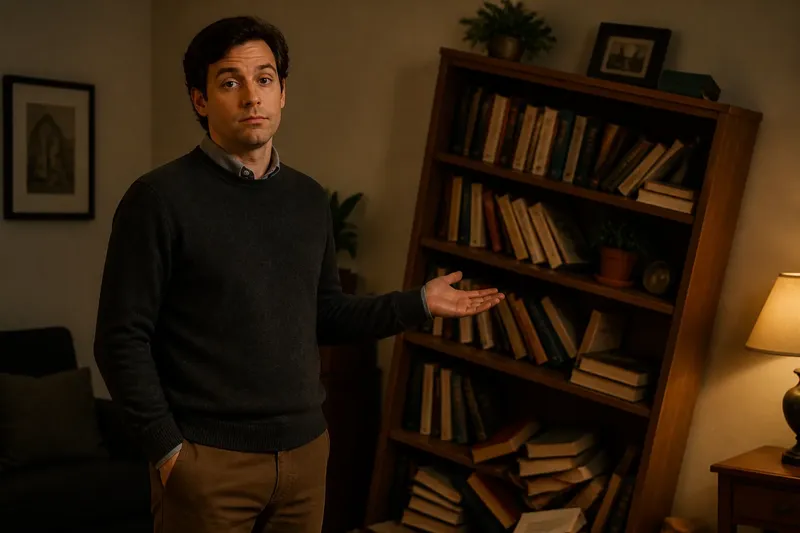
Imagine a character standing beside a badly leaning bookcase and saying, “That’s exactly where I meant it to go.” In a deadpan performance, the actor barely glances at the shelf. The line’s confidence clashes with the obvious disorder, so attention settles on the character’s claim and the room’s evidence.
The restraint can also make an ordinary sentence feel oddly official. A performer who delivers “I’ve made a small adjustment” without a hint of alarm gives the audience space to wonder what has happened. The humour comes from the audience’s work of comparison, not from a facial cue spelling out the joke.
Deadpan does not mean lifeless. Stillness is an active choice: the performer holds back a smile, a gesture or an explanatory pause that might otherwise direct the laugh. A tiny detail, such as a brief look at the bookcase after the line, can become striking precisely because the rest of the performance stays quiet.
What does a big reaction add to the same line?
An outsized reaction shifts attention from the line’s underlying mismatch to the performer’s response. The words can remain “That’s exactly where I meant it to go,” but the actor might stare at the leaning bookcase, recoil, and deliver the sentence with theatrical certainty. Now the audience watches a person struggling to maintain a claim in the face of visible evidence.
That extra display creates a second comic layer. The line says one thing; the body seems to know another. A gasp, an overlong blink or a grandly composed posture can make the character’s effort to appear untroubled more entertaining than the sentence alone.
Big reactions do not have to mean shouting or flailing. Scale is relative to the scene. A sharply lifted eyebrow may be an enormous response from a character who has been rigidly composed; a broad physical display may suit a farce in which the whole room is already in motion. The useful question is not “How big can this be?” but “How much change will the audience read?”
Let the reaction reveal a particular attitude. Panic, wounded pride and misplaced grandeur produce different comic textures, even if the line stays identical. Choose a response that belongs to the character rather than adding movement simply to decorate the joke.
How do the two styles direct attention differently?
Deadpan often points outward: towards a contradiction in the words, the setting or another character’s behaviour. A big reaction often points inward: towards the performer’s feelings, denial or attempt to control the moment. Neither style changes the joke’s wording, but each gives the audience a different route through it.
In a quiet exchange, a restrained delivery can invite listeners to catch a detail for themselves. In a more heightened scene, a larger response can make the performer’s physical behaviour the clearest signal. This is not a fixed rule about comedy formats. A scene’s pace, staging and character relationships all affect where attention naturally goes.
There is also a difference in how each style handles the beat after the line. Deadpan may leave a clean pocket of silence, allowing the words to settle before the next action. A big reaction can stretch that beat through visible effort: a character freezes, tries to recover, then returns to the conversation as though nothing happened. In either case, the pause works best when it has a purpose. Waiting longer is not automatically funnier.
For a short rehearsal, mark three things: the last word of the line, the performer’s first response, and the next person’s cue. Try a restrained version and a heightened version without changing those words. Notice whether the audience’s attention goes first to the contradiction or to the character’s response, then choose the version that serves the scene.
Which approach suits a character or scene?
Start with the character’s relationship to control. Someone who insists on calm while things go wrong may be funniest when the voice barely moves. Someone who cannot hide a feeling may generate more comedy through a sudden, outsized response. The choice should expose a trait, not just display an actor’s range.
Consider the scene’s other performers, too. If a scene partner is already delivering a large reaction, a deadpan reply can create contrast without competing for attention. If everyone remains still, one conspicuous reaction may provide a clear shift. Contrast can be produced by a single change in energy; it does not require every performer to choose opposite styles throughout.
The space matters. A close camera can register a small change in the eyes, while a distant audience may need a clearer physical signal. In a live room, sightlines and background movement affect what people can catch. Match the scale to what the audience can actually see, rather than assuming that louder or broader always reads better.
Say you are playing a receptionist who tells a visitor, “Your appointment is right on time,” while the waiting room is visibly chaotic. If the receptionist is committed to a polished professional manner, a level voice and a neatly squared stack of papers can make the denial funny. If the character is quietly losing patience, the same line might arrive with an elaborate inhale and a smile held too long. The first version directs attention to the mismatch between order and disorder; the second makes the strained performance of politeness the focus.
How can you rehearse both versions without rewriting the joke?
Keep a copy of the line in front of you and treat it as fixed. Change one performance choice at a time, so you can tell what is doing the work. For example, first keep the face still and vary the pause; then restore the original pause and change the physical response.
- Set the baseline: Say the line plainly, without adding a wink, gesture or extra phrase.
- Try restraint: Reduce facial movement and keep the voice steady, while remaining present in the scene.
- Try a larger response: Choose one readable change, such as a sudden turn, a delayed blink or a conspicuously controlled smile.
- Keep the wording constant: Do not add a tag, clarification or extra sound to make one version work.
- Watch the beat: Check whether the pause leaves room for the audience or becomes an empty wait.
- Play it in context: Include the preceding action and the next person’s cue, because timing and contrast depend on the exchange.
When reviewing a rehearsal, ask a precise question: what seemed to attract attention first? If the line’s contradiction disappeared beneath a busy reaction, reduce the display. If the character’s response felt too faint for the room, make one element clearer instead of enlarging everything.
Which details should you decide before choosing?
Does deadpan mean the actor should show no emotion?
No. Deadpan usually means keeping the outward response restrained, not playing the scene without thought. The performer can have a clear private intention, such as refusing to admit embarrassment, while showing very little of it.
Can a big reaction still feel controlled?
Yes. A response can be large in shape but exact in timing and focus. One deliberate recoil may read more clearly than a string of unrelated gestures.
Should the pause come before or after the punchline?
Place the pause where it clarifies the audience’s attention. A brief wait before the line can build expectation; a beat after it can let the contradiction or reaction register, provided the scene still feels alive.
Can the same performer switch between the styles?
Yes, and the change can reveal a character’s shifting control. A restrained line followed by a sudden physical reaction, or a burst of emotion followed by a flat reply, gives the audience a noticeable change in behaviour without altering the joke.
How do you choose the version that serves the joke?
Decide what the audience should notice first: the words’ contradiction, the character’s attempt to conceal a feeling, or the contrast between two performers. Use deadpan when stillness helps listeners read the situation; use a bigger response when the character’s visible reaction adds a meaningful comic layer.
Then check that the choice fits the scene’s scale and leaves the next beat clear. Deadpan or big reaction is not a contest between subtlety and energy. It is a decision about where the audience’s attention will go—and whether that destination makes the unchanged line more revealing.
For a useful final check, perform the line once without either style’s signature flourish. If the scene remains understandable, you can shape the delivery with confidence; if not, clarify the action around it before making the reaction larger.